🚀 What’s New in C#: The New AggregateBy LINQ Method
If you’ve ever written GroupBy(...).Select(g => ...) just to sum, count, or accumulate values by a key, the new AggregateBy LINQ method is for you.
Introduced in .NET 9 / C# 13, AggregateBy allows you to aggregate directly by key without creating intermediate groupings.
🧠 What is AggregateBy?
Think of it as Aggregate, but grouped by a key.
Instead of producing IGrouping<TKey, TElement> like GroupBy, it:
Uses a key selector
Maintains an accumulator per key
Returns (Key, Accumulator) pairs
This makes it ideal for simple and efficient “group + aggregate” scenarios.
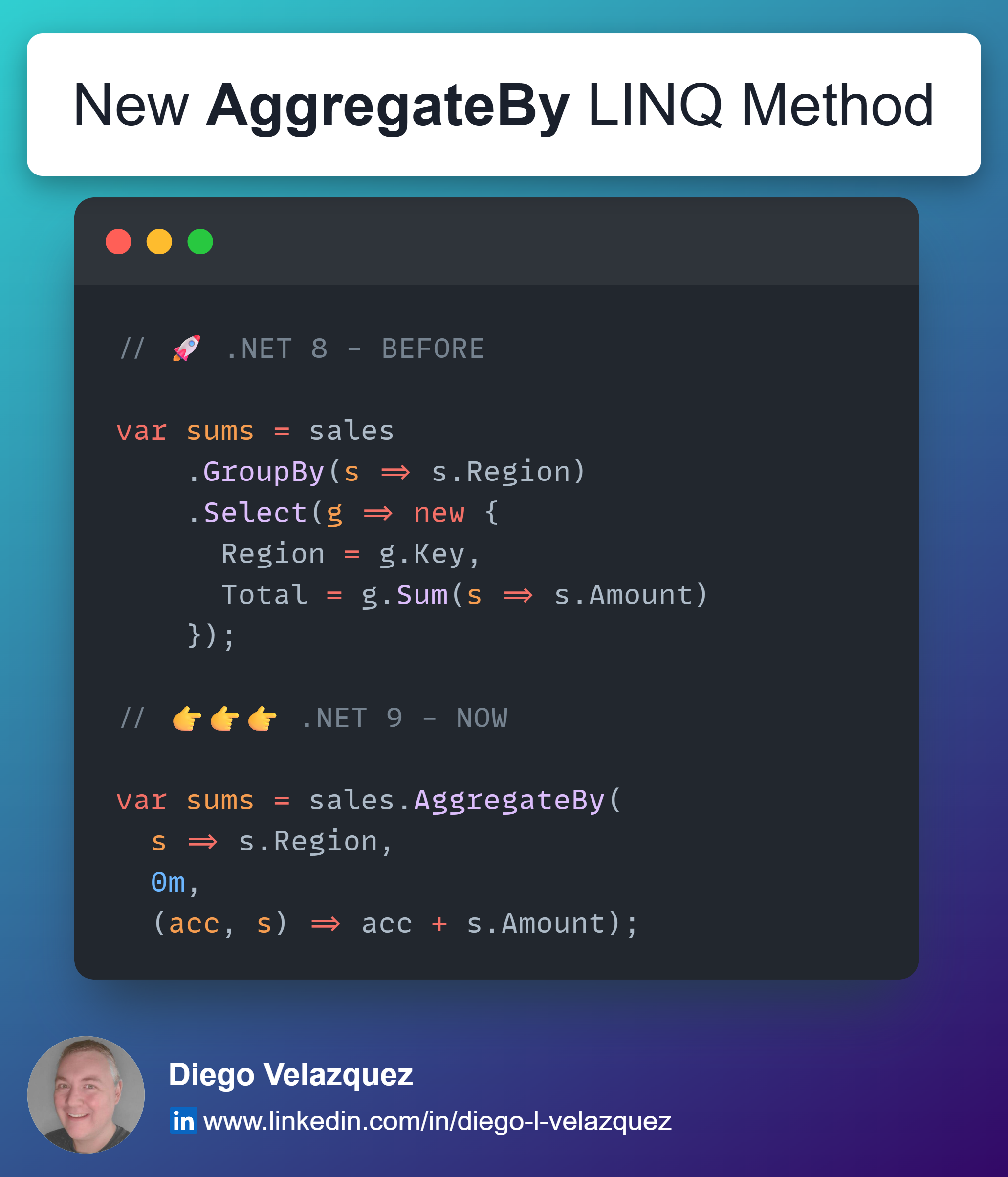
✍️ Before vs After ❌ Traditional approach with GroupBy
var totals = sales
    .GroupBy(s => s.Product)
    .Select(g => new
    {
        Product = g.Key,
        Total = g.Sum(x => x.Quantity)
    })
    .ToDictionary(x => x.Product, x => x.Total);
✅ Using AggregateBy
var totals = sales
    .AggregateBy(
        keySelector: s => s.Product,
        seed: 0,
        func: (acc, s) => acc + s.Quantity)
    .ToDictionary(x => x.Key, x => x.Value);
👉 Key difference: No IGrouping, no projection step — just direct aggregation per key.
🎯 When AggregateBy Really Shines
Totals or counts per key (sales per product, requests per endpoint, errors per type)
Custom accumulators (build DTOs, track min/max, keep last value, etc.)
Large collections where avoiding extra allocations matters
It’s especially useful when you don’t actually need a group — just the result.
#csharp #dotnet #developerexperience #cleanCode