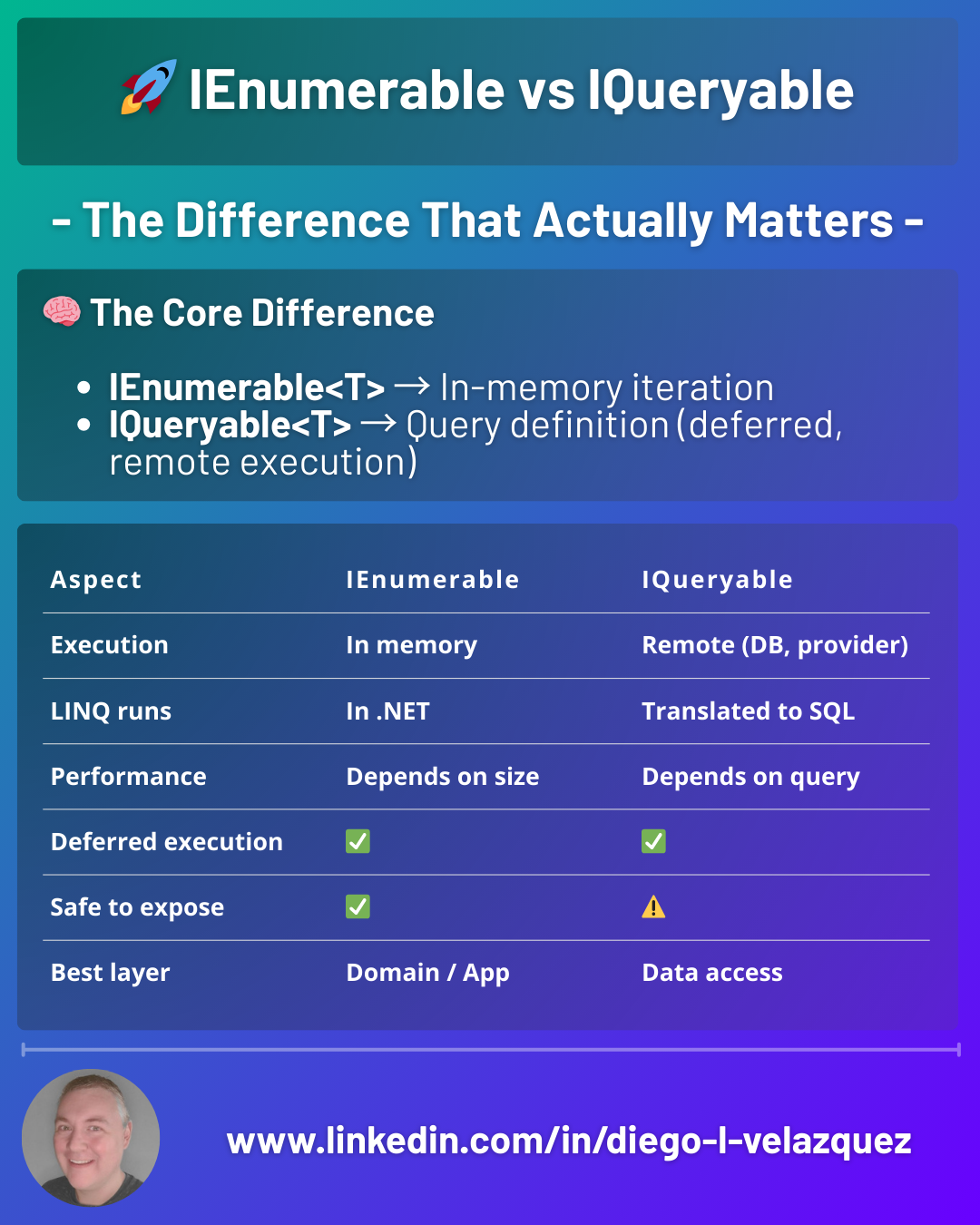
🚀 C# Tip — IEnumerable vs IQueryable (The Difference That Actually Matters)
IEnumerable and IQueryable look similar.
They’re not.
Choosing the wrong one can lead to:
- Performance issues
- Loading way too much data
- Queries that work in dev and explode in prod
Let’s clarify this once and for all.
🧠 The Core Difference
IEnumerable<T>→ In-memory iterationIQueryable<T>→ Query definition (deferred, remote execution)
That distinction drives everything else.
🧩 IEnumerable — In-Memory Execution
IEnumerable<Order> orders = GetOrders();

var expensive = orders
    .Where(o => o.Total > 100)
    .ToList();
What really happens:
- Data is already in memory
- LINQ runs inside your process
- Filtering happens after data is loaded
✅ When to use IEnumerable
- Collections already in memory
- Small datasets
- Business logic
- APIs returning final results
⚠️ Risks
- Accidental full-table loads
- Hidden performance costs
- Late discovery of inefficiencies
🧩 IQueryable — Query Translation
IQueryable<Order> orders = context.Orders;

var expensive = orders
    .Where(o => o.Total > 100)
    .ToList();
What really happens:
- LINQ builds an expression tree
- Provider (EF Core, LINQ-to-SQL) translates it
- Filtering runs in the database
✅ When to use IQueryable
- Data access layer
- EF Core queries
- OData / dynamic filtering
- Server-side paging, sorting, projection
⚠️ Risks
- Leaking
IQueryableoutside repositories - Runtime query translation errors
- Hidden N+1 queries
- Security & performance surprises
⚖️ Side-by-Side Comparison
| Aspect | IEnumerable | IQueryable |
|---|---|---|
| Execution | In memory | Remote (DB, provider) |
| LINQ runs | In .NET | Translated to SQL |
| Performance | Depends on size | Depends on query |
| Deferred execution | ✅ | ✅ |
| Safe to expose | ✅ | ⚠️ |
| Best layer | Domain / App | Data access |
🧠 The Most Common Mistake
❌ Returning IQueryable from repositories:
public IQueryable<Order> GetOrders()
{
    return _context.Orders;
}
Why this is dangerous:
- Leaks persistence concerns
- Couples callers to EF Core
- Makes performance unpredictable
✅ Better:
public Task<List<Order>> GetOrdersAsync()
{
    return _context.Orders
        .Where(o => o.IsActive)
        .ToListAsync();
}
🏗️ A Clean Rule of Thumb
- Use
IQueryableto build queries - Use
IEnumerableto consume data
Or even simpler:
IQueryablebelongs to the infrastructure layer
IEnumerablebelongs everywhere else
⚠️ Extra Gotchas (Real-World)
- Calling
.AsEnumerable()switches execution to memory - Mixing
IQueryable+ custom C# methods breaks translation IQueryableerrors show up at runtime, not compile time- Logging SQL is essential when using
IQueryable
🎯 Final Takeaway
IQueryable is powerful — and dangerous.
IEnumerable is safe — and sometimes expensive.
Choosing between them is not a syntax choice.
It’s a data flow and responsibility choice.
Most performance bugs start with
“It was just anIQueryable…”
#dotnet #csharp #linq #efcore #performance #softwarearchitecture #cleancode